Strings Attached: How Turkish Sounds Are Quietly Stealing the American Indie Scene
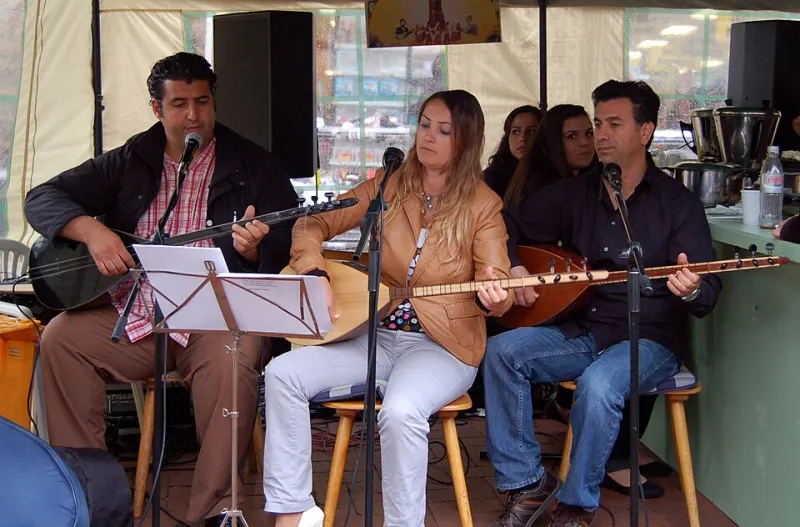
Photo: Huhu Uet, CC BY 3.0, via Wikimedia Commons
At a sold-out show in a 300-capacity venue in East Nashville last spring, something unexpected happened. Between sets, the crowd — mostly twentysomethings in vintage denim and chunky sneakers — started audibly humming a melody they'd just heard. It wasn't a guitar riff. It wasn't a synth hook. It was a saz line. Plaintive, modal, impossibly ancient-feeling, and somehow completely at home in a room that smelled like craft beer and anticipation.
The artist responsible was Deniz Karaer, a Turkish-American musician from Columbus, Ohio, who plays what she loosely describes as "Anatolian dream-pop." Her debut EP has racked up over two million streams on Spotify, landed her a feature in Pitchfork, and earned her a slot at three major indie festivals this summer. She's twenty-four years old.
"I spent years trying to figure out how to explain what I do," she says over the phone from a tour stop in Denver. "Now I just play it. People feel it before they understand it, and that's kind of the point."
A Different Kind of Alternative
For decades, the American indie and experimental music scenes have been remarkably porous — absorbing influences from West African rhythms, Japanese noise rock, Brazilian tropicália, and Afrobeat with genuine enthusiasm. But Turkish musical traditions have largely remained under the radar, known mostly to diaspora communities and a small circle of devoted world music enthusiasts.
That's changing, and it's changing fast.
A loose constellation of Turkish and Turkish-American artists is finding real traction with American audiences who are increasingly drawn to music that feels both unfamiliar and emotionally immediate. The common threads? Microtonal scales that seem to bypass the brain and go straight to the gut. Storytelling traditions that stretch back centuries. And a sonic palette — bağlama, ney, kanun, layered with modern production — that sounds like nothing else in the current indie landscape.
"There's a hunger for music that has actual roots," says Marcus Webb, a music journalist who covers the experimental scene for several independent outlets. "Not roots in the nostalgic, retro sense, but music that comes from a place of genuine cultural depth. Turkish music has that in abundance, and I think listeners are picking up on it even when they can't name what they're hearing."
The Makam Question
Ask any Turkish musician about what makes their musical tradition structurally distinct, and they'll eventually bring up makam — the modal system that underlies classical Ottoman and folk music. Unlike Western scales, makams use intervals that fall outside the standard twelve-tone system, creating emotional textures that can feel simultaneously melancholic, ecstatic, and unresolved in ways that Western listeners often find deeply arresting without quite knowing why.
Berke Önal, a Brooklyn-based multi-instrumentalist who records under the name Boğaz, has spent the last three years building a following by threading makam structures into electronic compositions. His music sounds, at various moments, like a late-night drive through a city you've never visited, a half-remembered dream, and a conversation you should have had years ago.
"The makam carries an emotional specificity that I don't think has an equivalent in Western music," he explains, his voice carrying the careful precision of someone who has thought deeply about this. "There are makams that are traditionally associated with specific times of day, specific emotional states, even specific seasons. When I work with those structures in a contemporary context, that emotional weight comes with them. It's not something I have to manufacture."
His track "Hüseyni at 3am" — named after one of the most beloved makams in Turkish classical music — went quietly viral on TikTok last winter, soundtracking thousands of late-night study sessions and introspective drives. The comments section reads like a therapy session: "why does this make me feel like I'm missing something I never had" and "I don't know what this is but I've listened to it 47 times."
Gen-Z and the Authenticity Imperative
It's worth asking why this is happening now. Turkish music didn't suddenly become interesting — it's been extraordinary for centuries. But the cultural moment may have finally caught up with it.
Gen-Z listeners, by almost every measure, are the most aesthetically adventurous generation of music consumers in American history. They've grown up with algorithmic recommendation engines that flatten geographic and cultural boundaries, making it as easy to discover a Turkish halk müziği playlist as a new Phoebe Bridgers record. More importantly, they've grown up in a cultural environment that places genuine premium on authenticity — on music that comes from somewhere real, that means something specific, that isn't assembled from trend-chasing.
"I think younger listeners have really good radar for what's genuine," says Karaer. "And Turkish music is deeply, unavoidably genuine. It carries centuries of actual human experience in it. You can't fake that, and I think people can tell."
There's also a diaspora dimension worth noting. The Turkish-American community has grown significantly over the past two decades, and second-generation Turkish-Americans — raised between two cultural worlds, fluent in both — are increasingly the ones making the music that's crossing over. Their dual identity isn't a tension to be resolved; it's the source material.
The Saz in the Room
Instrumentally, the saz (also known as the bağlama) has become something of a signature sound in this emerging scene. A long-necked lute with a distinctly resonant, slightly buzzy timbre, it's been the backbone of Anatolian folk music for centuries. In the hands of contemporary artists, it's being paired with synthesizers, drum machines, reverb-drenched production, and field recordings in ways that feel genuinely new.
Deniz Karaer plays a saz her grandmother brought from Sivas in the 1980s. "It's been restrung about a hundred times," she says, laughing. "But the body is original. When I play it, I'm very aware of that. It's not a prop. It's a connection."
That sense of connection — to family, to history, to a place that exists both in memory and on a map — might be the most powerful thing Turkish musicians are bringing to American stages right now. In a music landscape often accused of being rootless and disposable, they're offering something that can't be manufactured: the sound of somewhere real, carried in the hands of people who grew up between worlds.
The crowd in East Nashville hummed that saz line all the way to the parking lot.
Something is definitely happening.