Slick Roots: How an Ancient Turkish Sport Is Finding a New Home in America
Covered in Oil, Rooted in Something Real
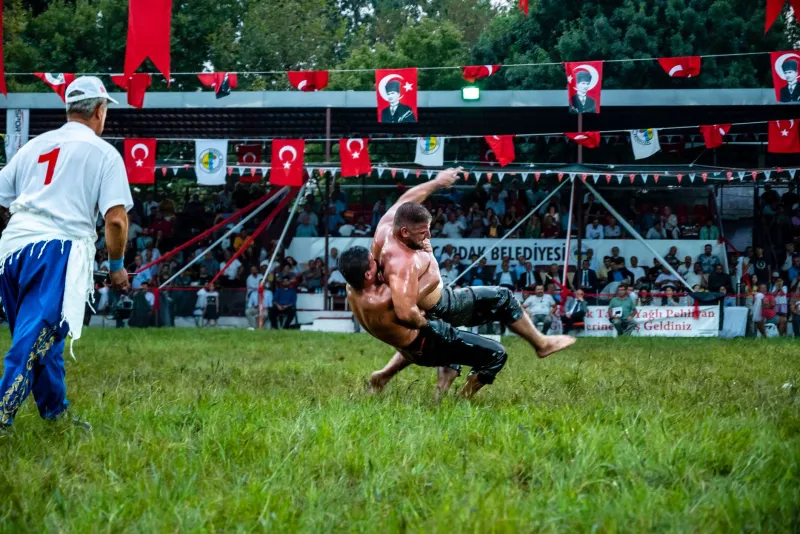
The first time Emre Çelik watched his father compete in a Yağlı Güreş demonstration at a Turkish cultural festival in New Jersey, he was nine years old and mostly confused. Two large men in kispet — the hand-stitched leather trousers that are essentially the sport's only uniform — were slathered head to toe in olive oil, locked in a grip that looked simultaneously ancient and completely chaotic. The crowd around them was electric in a way Emre had never seen at any American sporting event.
"I remember thinking it looked kind of insane," he says now, at 22, laughing from a gym in Paterson where he trains three days a week. "But I also couldn't look away. There was something about it that felt — I don't know — important. Like it was trying to tell me something."
What it was telling him, it turns out, was something about where he came from.
The Sport That Predates the Ottoman Empire
Yağlı Güreş — literally "oiled wrestling" — is not a quirky novelty act. It is one of the oldest documented competitive sports on the planet, with roots stretching back over 2,600 years. The Kırkpınar Oil Wrestling Festival, held annually in Edirne, Turkey, has been running continuously since 1362, making it the longest-running sporting event in recorded history. That's not a typo. Longer than the modern Olympics. Longer than most nations that exist today.
The rules are elegantly simple: two competitors, both coated in olive oil, attempt to pin or lift their opponent. The oil isn't theatrical — it's functional, making grip nearly impossible and demanding a very specific kind of technical mastery that takes years to develop. The kispet is filled with grass to absorb oil and provide grip, and matches can last hours at the highest levels of competition.
In Turkey, the sport carries enormous cultural prestige. A champion wrestler — called a başpehlivan — is a figure of national pride, something like what a Super Bowl MVP is here, but layered with centuries of historical weight.
Building Clubs Far From Edirne
For most of the Turkish diaspora in the US, Yağlı Güreş existed primarily as a memory — something you watched on grainy YouTube clips or heard your relatives talk about with reverence. But over the past decade, a quiet infrastructure has started to take shape.
Small wrestling clubs affiliated with Turkish cultural associations have been popping up in cities with significant Turkish-American populations: New York, New Jersey, Chicago, Houston, Los Angeles. They're not flashy operations. Often it's a rented gym space, a few experienced coaches who learned the sport back home, and a growing group of second-generation kids who showed up curious and stayed for reasons they're still figuring out.
Coach Murat Kaplan runs one such club out of a community center in suburban Chicago. He came to the US from Bursa fifteen years ago and spent the first few years missing the sport with an almost physical ache. "In Turkey, wrestling is everywhere," he says. "Here, I had to build it from scratch. But the kids — they come. And once they understand what this is, they don't want to leave."
Murat's club currently has about thirty regular members, ranging from ages twelve to mid-twenties. Roughly half are Turkish-American. The other half are a mix of American-born kids with no Turkish background whatsoever, who found the club through word of mouth or social media and were drawn in by the sport's sheer strangeness and physical demand.
Why Second-Generation Kids Are Showing Up
Ask any of the young Turkish-Americans training in these clubs why they started, and the answers orbit the same themes: a desire to connect with something specific, something that can't be faked or bought or scrolled past.
Selin Arsoy, nineteen, grew up in a household where Turkish culture was present but often felt abstract. Her parents spoke Turkish at home, they celebrated Bayram, they cooked Turkish food. But she always felt like she was observing her heritage from a slight distance, never quite inside it. She started training last year after her uncle took her to a demonstration match at a local festival.
"It's physical," she says simply. "It's in your body. You can't just read about it or watch a documentary. You have to actually do it, and when you're doing it, you're doing something that people in your family did hundreds of years ago. That's not nothing."
That embodied quality — the fact that the sport lives in muscle memory and physical practice rather than in text or image — seems to be exactly what makes it so resonant for young people navigating dual identities. It offers a form of cultural connection that doesn't require fluent Turkish or a trip to Edirne. It just requires showing up and getting covered in olive oil.
An Unexpected American Audience
Here's the plot twist nobody saw coming: American athletes with zero Turkish background are getting genuinely hooked.
Coach Murat has noticed that his non-Turkish students often become some of his most dedicated. He thinks he understands why. "American wrestling culture is strong — high school, college, there's a real tradition here," he says. "When these athletes discover Yağlı Güreş, they recognize the athleticism immediately. But then they start to learn the history, the culture, the philosophy behind it. And something opens up in them."
That crossover appeal is creating unexpected bridges. In several schools in New Jersey and Texas, Turkish-American community organizations have partnered with athletic departments to offer Yağlı Güreş workshops. The response has been enthusiastic enough to suggest that the sport has genuine mainstream potential — not as a replacement for American wrestling, but as a complement to it, carrying its own distinct tradition and meaning.
More Than a Sport
Emre Çelik still trains in Paterson. He's good enough now that he's been invited to compete at a Turkish cultural festival circuit that runs up and down the East Coast each summer. He doesn't know if he'll ever make it to Kırkpınar — though that's the dream — but he says the sport has given him something he couldn't have found any other way.
"When I'm wrestling, I'm not Turkish-American," he says. "I'm not in between anything. I'm just doing this thing that my people have done forever. For a few minutes, there's no hyphen."
That might be the most honest description of what Yağlı Güreş offers the diaspora: not an escape from the complexity of living between two cultures, but a brief, sweaty, olive-oil-soaked moment of clarity within it.