Glow Up, Grandmother's Way: How Turkish Skincare Secrets Are Taking Over American Bathrooms
The Bathroom Shelf Your Büyükannen Would Recognize
Walk into any Sephora right now and you'll find rose water facial mists lined up like little pink soldiers, each one promising dewy, luminous skin for somewhere between $28 and $65. What the packaging won't tell you is that Turkish women have been splashing rose water on their faces for centuries — not as a luxury, but as a Tuesday.
That quiet irony isn't lost on Defne Arslan, a Turkish-American esthetician based in Austin, Texas, who grew up watching her mother decant rose water from a plain glass bottle she bought at a Middle Eastern grocery store for about three dollars. "My mom would look at these fancy brands now and just laugh," Defne says. "She'd say, 'Kızım, we've been doing this your whole life. Why are you paying forty dollars for the same thing?'"
The answer, of course, is complicated. But the bigger story here isn't about price gouging or marketing spin. It's about what happens when a culture's everyday rituals get recognized — finally, properly — as genuinely brilliant skincare science.
What the Hamam Actually Does to Your Skin
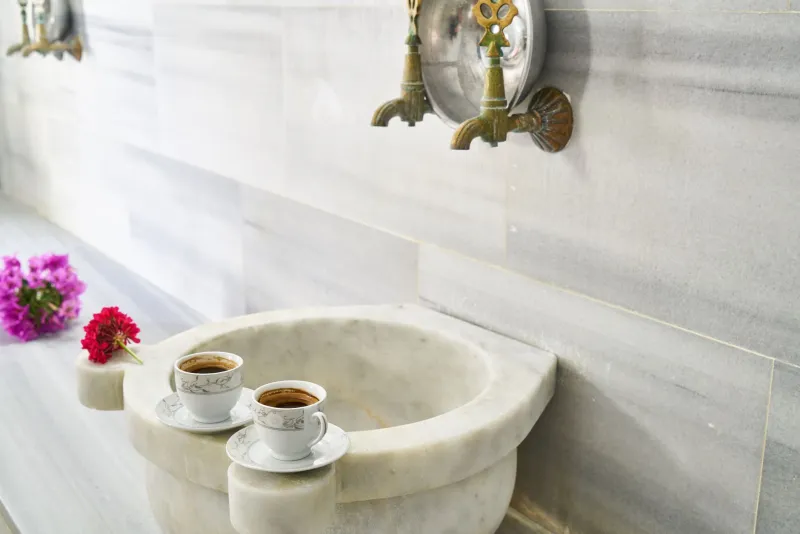
If you've ever stepped into a traditional Turkish bath, you already know it's not really about getting clean. It's about the full reset. The steam opens your pores. The kese mitt — that rough exfoliating glove that feels borderline aggressive the first time someone uses it on you — sloughs off layers of dead skin you didn't even know were there. The marble is hot. The air is thick. And by the time you're done, your skin feels like something that belongs on a completely different person.
Dermatologist Dr. Leyla Koç, who practices in New Jersey and sees a mixed patient base of Turkish-Americans and general wellness-curious clients, says the hamam ritual holds up under clinical scrutiny. "Physical exfoliation, sustained heat exposure, and steam are all evidence-backed methods for improving circulation, unclogging pores, and promoting skin cell turnover," she explains. "The hamam just packages all of that into one cohesive experience. It's honestly sophisticated when you break it down."
American spas have been offering "Turkish bath experiences" for a while now, but they've often been watered-down versions — more ambiance than substance. What's shifting is that Turkish-American entrepreneurs are stepping in to offer something more authentic, and consumers are hungry for it.
The Entrepreneurs Bringing It Home
Selin Yıldız launched her Brooklyn-based skincare line, Çiçek Glow, two years ago with a product lineup built almost entirely around ingredients she grew up with: olive oil, rose water, black seed oil, and fig extract. She didn't start out planning to build a brand. She started because she couldn't find anything on the market that matched what her grandmother used to make in their kitchen in Izmir.
"I moved to New York for grad school and my skin just fell apart," Selin says, laughing. "Different water, different air, different stress. I called my grandmother and she basically dictated a recipe to me over the phone. I made it in my apartment, my skin cleared up, and my roommates started asking what I was using."
What Selin figured out fast is that American consumers don't just want the product — they want the story. They want to know that the olive oil in the formula is cold-pressed from a specific region. They want to understand why black seed oil, known in Turkish as çörek otu yağı, has been used medicinally for thousands of years. "People here are so ready to learn," she says. "They're tired of being sold chemicals with French names. They want something that feels real."
Selin isn't alone. Across the country, a small but growing cohort of Turkish-American beauty founders are building brands that center heritage without turning it into costume. In Chicago, a former pharmacist named Tarık Demirci has been formulating a men's grooming line anchored in traditional Turkish barbershop rituals. In Los Angeles, a mother-daughter duo is bottling the exact bay laurel soap — defne sabunu — that's been made in Antakya for generations.
Olive Oil Is Not Just for the Kitchen
Here's the thing about olive oil that most Americans are still wrapping their heads around: it's a deeply serious skincare ingredient. Rich in squalene, vitamins E and K, and oleic acid, it's been used as a moisturizer, hair treatment, and nail conditioner across the Mediterranean and Middle East for millennia. Turkish women have been massaging it into their cuticles, running it through their hair before washing, and mixing it into homemade face masks basically forever.
Dr. Koç points out that the science supports the practice. "Oleic acid in particular has strong emollient properties — it helps maintain the skin barrier and prevents moisture loss. For dry skin types especially, it's genuinely effective."
The catch is that not all olive oil is created equal, and the cheap stuff at the grocery store isn't what your Turkish grandmother was using. Extra virgin, cold-pressed, ideally from a single estate — that's the version that carries the most bioactive compounds. A growing number of Turkish-American importers are now making it easier to source the real thing in the US, which means the kitchen-to-bathroom pipeline is more accessible than ever.
Making It Your Own
For readers who want to start somewhere without overhauling their entire routine, Defne has a simple suggestion: rose water toner, every morning and night. "Just that one swap," she says. "You'll feel the difference in a week."
Beyond that, she recommends finding a hamam or Turkish bath experience in your city at least once a season. Many major US cities — New York, Chicago, Los Angeles, Houston — now have authentic options. "It doesn't have to be a whole lifestyle overhaul," she says. "But once you try it, you'll understand why Turkish women have been doing this for generations. Your skin will tell you everything you need to know."
Maybe that's the real lesson here. Turkish skincare isn't a trend that arrived on an influencer's feed. It's a body of knowledge passed down through kitchens and hamams and phone calls with grandmothers. The American beauty industry is just finally catching up.