Your Doctor's 'Mediterranean Diet' Has Nothing on Your Grandmother's Table
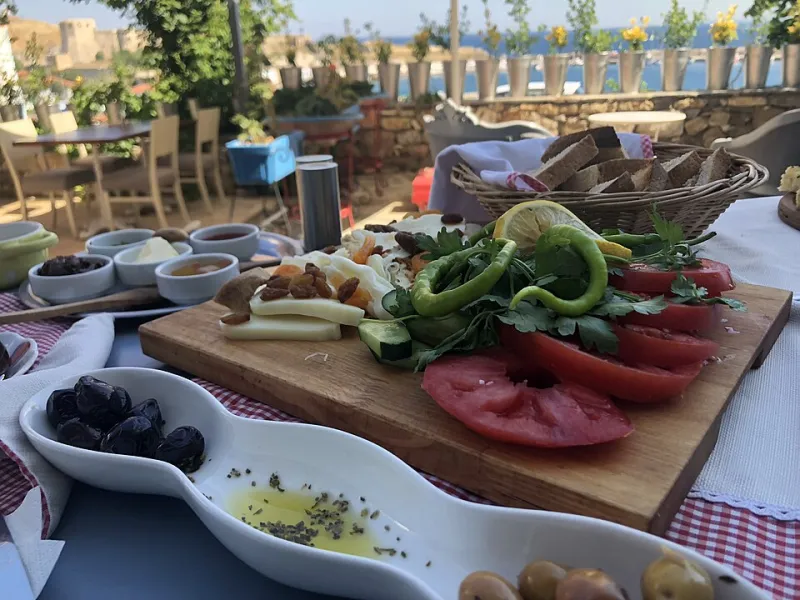
Photo: Glassmug29, CC BY-SA 4.0, via Wikimedia Commons
My doctor is a kind man with good intentions and a laminated sheet.
At my last physical he slid it across the desk: the Mediterranean diet. Olive oil. Fish twice a week. Whole grains. Vegetables. Beans. A modest amount of dairy. Red meat occasionally, if you insist. Possibly a glass of red wine, though he said this in the tone of a man who has learned not to promise anything.
I took the sheet home and called my grandmother in Izmir to tell her about it. I got about four items in before she started laughing.
The phone call
“Olive oil,” she repeated. “They discovered olive oil.”
She was standing in her kitchen, I could tell, because there was the sound of a spoon against a pot and the small clatter of a saucer being set down. She asked what else was on the sheet. I read it out: vegetables, legumes, yogurt, fish, a little cheese, bread with meals, sweets rarely.
There was a pause. Then: “This is not a diet. This is Tuesday.”
She was not wrong, and she was not entirely right either, and that gap is where I have been living for most of my adult life.
The handout is a translation
The Mediterranean diet, as it arrives in an American clinic, is a stripped-down export. It is not wrong — the research behind it is real, built partly on mid-century studies of Greek and southern Italian eating patterns, and it consistently performs well in trials. But the version most of us receive has been processed for American consumption. Big Food sells olive oil in misting bottles. Yogurt arrives in single-serve cups with a flavor and a marketing budget. The culture gets filtered out and the shopping list gets mailed in.
What is left is a set of nutrients with the table removed. And the table was never a side detail.
Olive oil is not a drizzle
In an American kitchen, finishing oil is a flourish — a thin shine on a plate, applied with restraint and a certain smugness.
In a Turkish kitchen, olive oil is a unit of measurement. There is a whole category of dishes named for it. It is poured, not drizzled, and a pot of green beans cooked in it is not a health food pretending to be a vegetable dish. It is lunch.
That difference is not just culinary. When you translate your food into wellness language, you shrink it. You turn a centuries-old kitchen into a compliance exercise.
Yogurt goes on everything
My grandmother's yogurt is a condiment, a sauce, a side, and occasionally a religion. It goes on rice. On pasta. On dumplings. On fried vegetables. On squash. On top of a bowl of soup that was already perfectly fine, honestly, but now it is better.
Wellness culture has discovered this and rebranded it as a probiotic strategy. Which is accurate and completely misses the point. Nobody at my grandmother's table is eating yogurt for gut flora. They are eating it because it is cold and tangy and it cuts through the olive oil, and because it has been on that table every day for sixty years.
Where the American version goes sideways
The real friction is not that the handout is bad. It is that it teaches you to see your own food as a nutrition delivery system, and once you start doing that, you never stop. Every dish becomes a compliance question. Bread gets interrogated. Rice becomes a threat. The tea has sugar in it, so the whole afternoon is compromised.
And here is the uncomfortable part: my grandmother's table is not automatically healthy. There is white bread, there is sugar, there is butter folded into pastry, there are winter stews that could stop a truck. Nobody at that table is thinking about glycemic load, and nobody at that table is going to start.
The point is not that the traditional table is a flawless health plan. The point is that it does not need a permission slip from a wellness brand to exist.
Stop apologizing at the office
I have watched Turkish-American friends describe their lunch in a way that pre-emptively apologizes for it. “It's kind of like a Greek salad.” “It's basically a frittata.” “It's just eggs.” It is not just eggs. It is menemen, and it is better than the thing you are comparing it to.
We do this because it is easier to borrow someone else's frame than defend our own. But the borrowing has a cost. Every time you describe your food as the American version of itself, you quietly agree that the original was not quite appropriate for the room.
What the sheet gets right, and what she gets right
Be fair to the doctor. He is right that vegetables are good, that legumes are cheap and excellent, that olive oil beats most alternatives, that processed food is a problem, and that eating with other people probably does more for you than any single ingredient on the page.
Be fair to my grandmother, too. She is right that a meal is not a medical intervention. She is right that a table with eight small dishes and two people at it is a different experience from a plate with portions arranged into a chart. She is right that nobody has ever felt better after being lectured about fiber.
The version I have landed on is unglamorous: eat the way the table taught me, skip the buzzwords, and bring the sheet to the next checkup just to prove I read it.
The only rule
If a wellness influencer ever tells you to “deconstruct” your grandmother's cooking into its nutritional components, tell them she already did that. It is called dinner, and it has been working fine since long before anyone put a percentage on it.