One Parent, Two Languages: Inside the Mixed Families Refusing to Let Turkish Fade
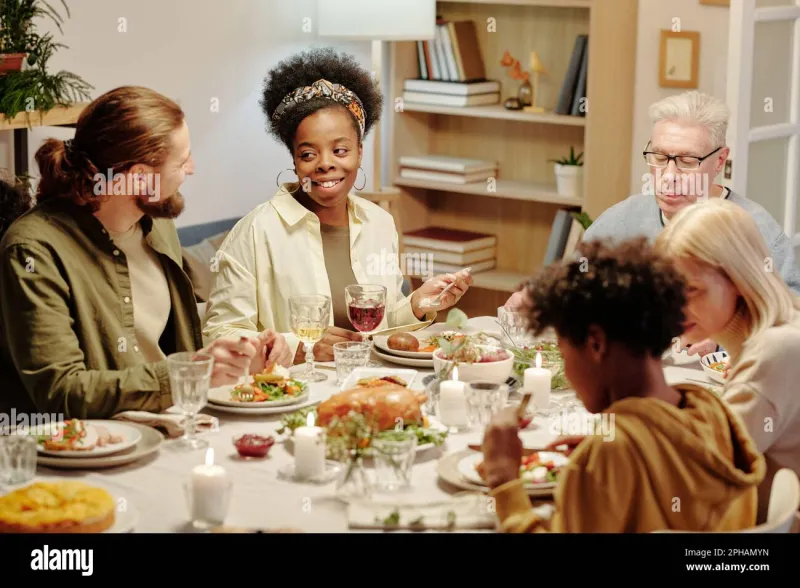
Photo: multicultural family dinner table parents and children talking at home, via c8.alamy.com
The scene repeats itself in Turkish-American homes from Paterson to Plano: a Turkish mom or dad starts a sentence in Turkish, the kids answer in English, and the non-Turkish spouse smiles politely, catching maybe every fifth word.
It's charming at first. Then it becomes a question: will these kids actually speak Turkish, or just recognize the sound of their grandmother's voicemails?
The Math Is Not on Your Side
Second-generation Turkish-Americans are marrying outside the community at rates their parents' generation rarely did, which is lovely for love and complicated for language. Speech-language researchers call it the "minority language at home" problem: English has gravity. School, screens, teammates, YouTube — everything pulls kids toward English with the force of a black hole. Turkish gets, what, dinner and a FaceTime with Babaanne?
Dr. Elif Karahan, a bilingualism researcher who consults with families in New Jersey, puts it bluntly: "A language doesn't survive on affection. It survives on necessity. If a child never needs Turkish, they'll become a passive listener — they'll understand everything and answer in English. Parents are often shocked when that counts as failure to them."
What Actually Happens at the Table
We asked three mixed families how they handle it.
Meryem and Josh, married eleven years in suburban Chicago, run what linguists call the "one parent, one language" model — Meryem speaks only Turkish to their two kids, Josh only English. "For the first three years I felt like a broken radio nobody listened to," Meryem laughs. "My son would answer in English no matter what language I used. I cried about it more than once."
Then the family spent a summer in Izmir with Meryem's parents. Her son, suddenly unable to order his own simit, had his breakthrough. "Need," as Dr. Karahan promised, did the work that affection couldn't.
In Raleigh, Deniz and his wife Angela chose a different route: Turkish as the "kitchen language." Cooking, meals, and food shopping happen in Turkish; everything else is fair game. "It's not total immersion, but it's honest," Deniz says. "Turkish is the language of our food. That's a real place in a kid's life."
And in Los Angeles, single dad Baris admits he lost the battle with his teenage daughter — until a Turkish exchange student stayed with them for a semester. "She wanted to gossip with someone I couldn't understand," he says. "Turkish became the cool secret language. Teenagers. Go figure."
The Spouse Question Nobody Talks About
Here's the part that doesn't make it into the parenting books: what about the partner who doesn't speak Turkish?
Some non-Turkish spouses describe feeling excluded during phone calls with in-laws, or sidelined when the Turkish half of the conversation gets warm and fast. Others have turned it into a project — Angela started taking Turkish classes on an app two years ago. "I'll never be fluent," she says. "But when my mother-in-law heard me say a full sentence, she cried. It bought me a kind of belonging I didn't know I was missing."
Family therapists who work with intercultural couples suggest a simple rule: no one gets left in the dark. Translate, or switch to English. A shared language at the table matters more than a preserved one.
Does One Culture Have to Win?
The parents we spoke to kept rejecting the premise of the question. It's not a contest, they insisted — but their stories suggested the dinner table is where the score quietly gets kept. Which language the jokes land in. Which holidays get the good food. Whether the kids say "teşekkürler" or "thanks" when handed a plate.
Dr. Karahan's advice is refreshingly unromantic: pick a structure, commit to it for at least five years, and engineer need — a cousin video call every Sunday, a Turkish Saturday program, a summer trip that isn't optional. "Bilingualism in a mixed family isn't an accident that happens if you love your culture enough," she says. "It's infrastructure. You build it or you don't."
The kids, for their part, seem to appreciate the effort even when they resist it. Meryem's son, now fourteen, put it best: "I used to think it was annoying. Then I realized I can talk trash in two languages and insult nobody's intelligence. That's just more game than my friends have."
More game. More family. More of the map. Not a bad inheritance for a language that only gets the dinner table.