From Embarrassing to Essential: How Turkish-American Kids Finally Claimed Their Musical Roots
There's a very specific kind of cringe that only children of immigrants understand. You're thirteen, your mom is driving your friends home, and suddenly Sezen Aksu is blasting through the car speakers at full volume. You reach for the volume knob. Your mom swats your hand away. Your friends ask, what language is that? You say, "I don't know."
You knew. You just weren't ready yet.
For a huge chunk of Turkish-Americans who grew up in the '90s and 2000s, Turkish music was something that lived in the kitchen, in the car, at family gatherings where the adults cried a little and nobody explained why. It wasn't cool. It wasn't something you put on at a sleepover. It was background noise to a life you were desperately trying to make look as American as possible.
But something has shifted — and it's shifting fast.
The Algorithm Didn't Care About Your Embarrassment
Ask any Turkish-American in their twenties or thirties how they fell back in love with Turkish music, and there's a solid chance the answer involves a screen at 1 a.m. and a recommendation they didn't ask for.
"Spotify just started serving me Müzeyyen Senar one night and I was like, wait — this is incredible," says Defne, a 26-year-old graphic designer based in Chicago. "I'd heard that voice my whole life at my grandparents' house and I never actually listened. The algorithm did what my family couldn't."
That's not an isolated experience. Streaming platforms have quietly become one of the most powerful tools for diaspora reconnection. When you're a second-generation kid, you don't always have the language to ask your parents for a music education. But an algorithm doesn't need you to ask. It just notices that you paused on something, played it again, and connects the dots.
TikTok has taken that a step further. Turkish trap, Turkish pop, and even Ottoman classical compositions have all found unexpected audiences through the platform's borderless feed. A sound from a Şebnem Ferah ballad ends up under a trending audio. A clip of a saz player goes viral in the folk music corner of the app. Suddenly, a kid in New Jersey who used to hide his mom's CDs is sharing Tarkan edits with his college friends.
It's Not Just Nostalgia — It's Identity Work
The reclamation of Turkish music among younger diaspora members isn't simply about rediscovering old favorites. For many, it's tied up in a much bigger project: figuring out who they actually are.
"I spent so long trying to be fully American," says Emre, a 31-year-old DJ who performs under a name that blends Turkish and English. "And at some point I realized that wasn't working either, because I was never going to be fully American the way my white classmates were. So I started asking myself what I'd been throwing away to try."
For Emre, Turkish music became a way back in. He started digging into Anatolian rock from the '70s — artists like Cem Karaca and Erkin Koray — and found something that felt both foreign and deeply familiar. "That music already had the fusion in it," he says. "It was Turkish musicians absorbing Western rock and making something completely their own. That's basically what I'm doing now."
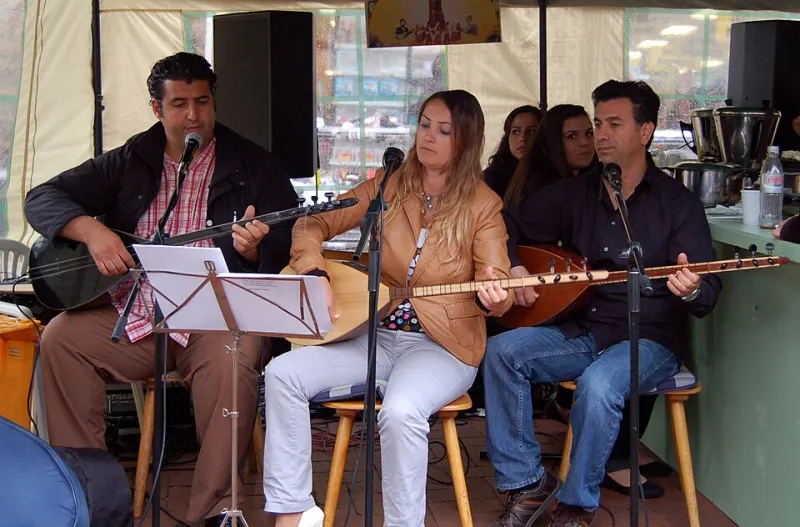
He's not alone in that lineage-drawing. Across the country, Turkish-American musicians and DJs are creating work that layers Ottoman makam scales over hip-hop beats, samples Arabesk singers over electronic production, or weaves bağlama melodies into indie folk arrangements. The point isn't to recreate something. It's to build something that couldn't exist without both sides of the hyphen.
The Group Chat That Changed Everything
Social media has also done something that formal cultural institutions sometimes struggle with: it's created community at scale without requiring anyone to show up anywhere.
There are Turkish-American music groups on Discord and Reddit, playlist-sharing threads on Twitter, and entire Instagram accounts dedicated to surfacing deep cuts from Turkish music history. For diaspora kids who grew up in places without a large Turkish community — a small town in Ohio, a suburb of Phoenix — these spaces have been genuinely transformative.
"I grew up in a place where I was basically the only Turkish kid," says Lale, a 24-year-old from Columbus who now runs a Spotify playlist with over 4,000 followers that mixes contemporary Turkish artists with American indie. "Finding other people online who were going through the same rediscovery thing made it feel less like homework and more like something exciting."
Her playlist is deliberately mixed — a Sertab Erener track sitting next to a Phoebe Bridgers song, Mor ve Ötesi flowing into Vampire Weekend. "I want it to feel like my actual taste," she says, "which is both things at once."
The Parents Are Watching, Quietly Thrilled
There's a particular kind of joy that Turkish immigrant parents experience when their American-raised kids start voluntarily playing Turkish music. They tend not to make a huge deal out of it — at least not immediately — but they notice.
"My mom texted me a heart emoji when she saw I added a Zeki Müren song to my Instagram story," Defne laughs. "She didn't say anything else. She didn't have to."
For many parents who watched their children spend years distancing themselves from Turkish culture, these small moments carry a lot of weight. Music, maybe more than language or food or religion, has a way of bypassing the arguments about assimilation and landing somewhere softer.
And honestly? The kids who once turned down the volume are starting to understand what their parents were feeling all along. That Sezen Aksu song isn't just a song. It's a whole life, a whole country, a whole set of memories that got packed into a suitcase and carried across an ocean. Listening to it now — really listening — is a way of honoring that.
Turning It Back Up
The Turkish-American musical reclamation happening right now isn't a trend in the disposable sense. It's something more durable: a generation doing the emotional work of integration on their own terms, using the tools available to them, and refusing to choose between the two worlds that made them.
The Spotify playlists are getting longer. The TikTok saves are stacking up. And somewhere, in a car in the suburbs, a Turkish-American kid is letting their mom's music play all the way to the end.
Volume up.