Put the Pod Down: What Turkish Coffee Taught Me About Actually Tasting Life
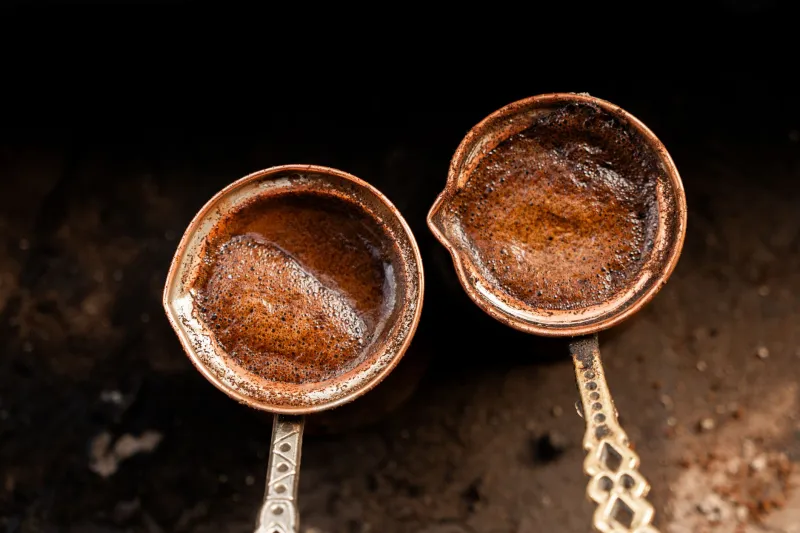
The Cup That Refuses to Be Rushed
Let's be honest. Most of us are drinking coffee wrong — at least by Turkish standards.
We're talking about the travel mug balanced on the car roof while you fumble for your keys. The lukewarm oat milk latte you finally remember at 11 a.m., long after the ice has watered it down to nothing. The K-Cup you hit 'brew' on before your eyes are even fully open.
American coffee culture is fast, functional, and deeply committed to getting you caffeinated with minimum friction. And honestly? There's a time and place for that. But somewhere between the cold brew on tap and the app that lets you order before you even walk in the door, we've lost something — the idea that making coffee could be an experience rather than a transaction.
Enter the cezve.
What Makes Turkish Coffee Different (It's Not Just the Grounds)
Turkish coffee isn't a roast or a bean variety. It's a method — and more than that, it's a mindset. The coffee is ground to an almost powdery fine consistency, combined with cold water (and sometimes a pinch of cardamom or sugar, depending on preference) in a small, long-handled copper or brass pot called a cezve. Then it's heated slowly over low heat — traditionally over sand or an open flame — until a thick foam rises to the top.
Here's the key part: you don't rush it. You watch it. You pull it back just before it boils, let the foam settle, and heat it again. Sometimes twice. The whole process takes around fifteen minutes, and that's kind of the point.
The result is a small, intensely flavored cup — usually served in a delicate porcelain demitasse alongside a glass of water and maybe a piece of Turkish delight. You sip it slowly. You let the grounds settle. You talk to whoever is sitting across from you.
For many Turkish-Americans, this ritual is one of the most grounding connections to home they carry with them.
Coffee as a Social Contract
In Turkey, there's a saying: "Bir fincan kahvenin kırk yıl hatırı vardır." Roughly translated, it means a single cup of coffee creates a friendship that lasts forty years. That's not just a pretty phrase — it reflects a genuine cultural value around hospitality and presence.
When you're offered Turkish coffee in a Turkish home, you're not being handed a beverage. You're being invited into a moment. The host asks how you take it — sade (plain), az şekerli (a little sweet), orta (medium sweet), or çok şekerli (very sweet) — and prepares your cup specifically for you. That small act of attention matters.
Turkish-Americans often describe this as one of the sharpest cultural contrasts they navigate. "Here, you hand someone a Starbucks cup and you're being thoughtful," laughs Selin, a Turkish-American living in Chicago who hosts a monthly kahve gathering in her apartment. "Back home, my grandmother would have been up at 6 a.m. grinding the coffee by hand. The effort was the gift."
Bringing the Ritual to an American Kitchen
The good news? You don't need a sand pit or a trip to Istanbul to do this right. Turkish coffee has quietly found its footing in American kitchens, especially in cities with established Turkish-American communities like New York, Houston, and Los Angeles.
Here's a simple starting point for brewing at home:
What you'll need:
- A cezve (available on Amazon, at Middle Eastern grocery stores, or Turkish specialty shops)
- Finely ground Turkish coffee — brands like Kurukahveci Mehmet Efendi are widely available online
- Cold water (filtered works great)
- Sugar, if desired
The method:
- Measure one heaping teaspoon of coffee per demitasse cup of cold water.
- Add your sugar now if you want it — don't stir it in later.
- Place the cezve over the lowest heat setting on your stove.
- Stir gently a few times as it begins to warm.
- Watch for the foam to rise. Right before it boils, remove it from the heat.
- Pour a little of the foam into each cup first, then slowly pour the rest.
- Wait two minutes before drinking — the grounds need to settle.
That's it. Fifteen minutes. No app required.
The Fortune at the Bottom of the Cup
Once you've finished your coffee, don't rinse that cup just yet. If you're in the mood, flip it upside down onto the saucer, let it cool, and hand it to someone who knows how to read kahve falı — coffee fortune telling.
This tradition, rooted in Anatolia and still very much alive in Turkish households across the U.S., involves interpreting the dried coffee grounds left on the inside of the cup. Symbols, shapes, and patterns are read like a map of what's to come — love, travel, news from afar, a surprise visitor.
Is it predictive? Probably not. But that's almost beside the point. Kahve falı is a reason to linger. It's an excuse to stay at the table a little longer, to laugh with the person reading your cup, to be curious together about what the future might hold.
In a culture that treats coffee as fuel, that kind of imaginative pause feels almost radical.
Slowing Down Isn't Falling Behind
What Turkish coffee ultimately offers isn't just a different flavor profile. It's a different relationship with time — and with the people you share it with. For Turkish-Americans balancing two worlds, that fifteen-minute ritual can feel like a lifeline back to something quieter and more intentional.
You don't have to abandon your cold brew habit. But maybe once a week, skip the app, pull out the cezve, and make someone a cup the old way. Ask how they take their sugar. Wait for the foam to rise. Let the grounds settle.
Some of the best conversations happen when nobody's in a hurry to leave.