That Blue Eye on the Endcap: What Nazar Loses When It Becomes Decor
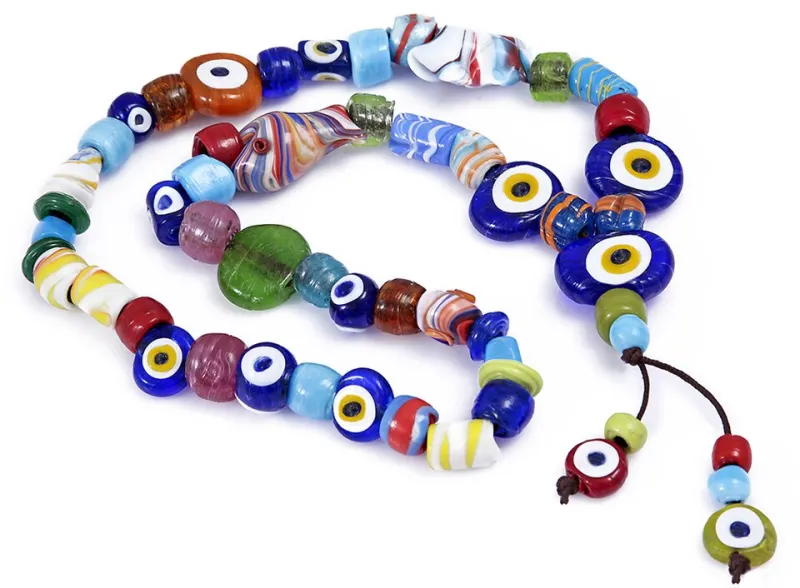
Photo: Aliakyuz, CC BY-SA 4.0, via Wikimedia Commons
There's a particular facial expression Turkish-Americans make in the home-goods aisle. It's not outrage exactly. It's closer to the look you'd give a stranger wearing your family crest on a beach towel: startled, a little amused, unsure whether to say something.
The nazar boncuğu — the blue glass eye — has been showing up on American endcaps for a while now. Sometimes it's $6 and made of machine-pressed glass. Sometimes it's $48, hand-blown, on a linen card with a paragraph of copy about 'ancient protection.' Both are hanging in someone's entryway in Ohio by the weekend.
It was never supposed to be pretty
The bead's job is specific. It's made to catch the look — the covetous glance, the compliment that lands slightly wrong, the neighbor who admires your new couch a beat too long. You hang it by the door, pin it to a baby's blanket, tuck one into a new car. Function first, aesthetics second.
The blue isn't decoration, either. It's a mirror. The eye is what gets looked at, so you don't.
The workshops have names
Most of the glass comes from workshops in and around Kemalpaşa and Görece, near İzmir, where families have been pulling these out of the furnace for generations. A hand-blown nazar has a wobble to it, a seam, a slight asymmetry. Machine-made ones are perfect and a little dead. If you hold two side by side, you can usually tell which one had a person behind it.
What the English name does to it
In English it arrives as 'evil eye,' which sounds like the thing itself rather than the defense against it. That one translation slip does a lot of work. Buyers in the US tend to pick one up as a general-purpose good-vibes object, a dreamcatcher with better branding, when the original concept is narrower and weirder: envy is the enemy. The reflex compliment, the cousin who wants your job, the friend who says your apartment is amazing in a tone.
Which is why the word that travels with it in Turkish is maşallah — said out loud, on purpose, to defuse the compliment before it curdles.
The tattoo question
Walk into enough American tattoo studios and you'll find the bead rendered in blue ink on somebody's forearm, usually with a caption like 'protection.' Turkish-American tattoo artists describe a split reaction in their own chairs: some clients want the story, some want the shape. The ones who want the shape aren't committing a crime. But the shape carries a family, and sometimes the artist says so, and sometimes the client listens.
The ownership fight gets sillier when you zoom out. The eye appears across Greek, Levantine, Armenian, and North African traditions too. Asking 'whose symbol is this' tends to produce the wrong conversation. The better question is 'whose grandmother had one by the door,' and the answer is: a lot of people's, and that's the point.
The shopkeepers who can tell the difference
Small Turkish-owned shops in Brooklyn, Paterson, Chicago, and Houston overwhelmingly sell both versions — the inexpensive import and the hand-blown piece from a workshop they can name. Store owners say the same thing in different words: they'd rather a customer leave with a real one, but they'd also rather the customer leave with something than nothing.
The irritation surfaces when a mass-market label markets a molded import as artisanal heritage. That's not a translation problem. That's copywriting.
So buy the ugly one
Here's the practical version of the argument. If you want a nazar in your house, buy one from a seller who knows where it was made. Hang it where it's supposed to go — by the door, facing out. And learn the reflex: when you admire something, say maşallah. Give the thing you love a verbal shield.
Meaning, in the end, lives in use, not in merchandise. A blue bead on a backpack in Nebraska isn't a small tragedy. A blue bead nobody knows how to use is just glass.
Which is fine, as long as somebody in the house eventually learns the rest of it.